Mastering Daily Vocabulary with the Arabic Adjectives Activity Book
Learning a new language is often compared to building a house. You need a solid foundation of grammar and a sturdy framework of verbs, but it is the descriptive words—the adjectives—that paint the walls, add texture to the rooms, and truly make the structure feel like a home. For learners of Arabic, mastering adjectives is not just about expanding vocabulary; it is about gaining the ability to express nuance, emotion, and specific details in daily conversation. This is where targeted resources become invaluable. The Arabic Adjectives Activity Book serves as a specialized tool designed to bridge the gap between basic recognition and active usage, making it an essential asset for both self-learners and educators.
Why Adjectives Are the Key to Fluency
Many beginners focus heavily on nouns and verbs, which allows them to construct simple, functional sentences. However, communication often stalls when one needs to describe quality, size, color, or feeling. Without adjectives, language remains flat and utilitarian. By integrating descriptive words into your lexicon, you transform "I ate food" into "I ate delicious, warm food." This shift is critical for achieving conversational fluency.
The challenge with Arabic adjectives lies in their agreement rules. Unlike English, where adjectives generally remain static regardless of the noun they modify, Arabic adjectives must agree with the noun in gender, number, definiteness, and case. This grammatical complexity can be daunting for beginners. A well-structured resource simplifies this process by isolating common adjectives and presenting them in contexts that highlight these agreements naturally, rather than through dry theoretical explanations.
A Resource Designed for Bilingual Success
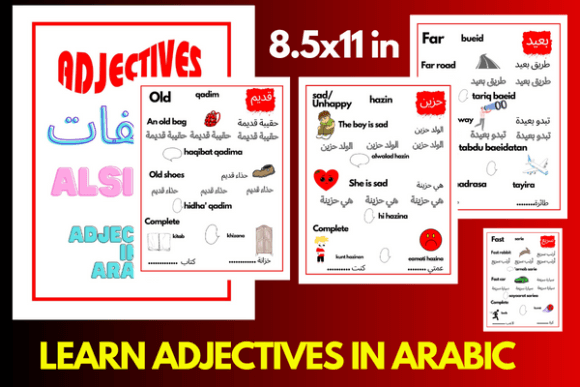
The Arabic Adjectives Activity Book was created with a specific audience in mind: bilingual children and early-stage learners who benefit from visual and contextual learning. The book features fifteen core adjectives that are highly relevant to daily life. These are not obscure literary terms but practical words used in everyday interactions, such as describing objects, people, weather, and emotions.
What sets this resource apart is its dual-language approach. By pairing English translations directly with Arabic script and phonetic guidance, it reduces the cognitive load for learners. This side-by-side comparison allows students to make immediate connections between concepts they already understand in English and their new Arabic equivalents. For bilingual children, this reinforces their heritage language while supporting their dominant language, creating a balanced learning environment that encourages confidence rather than frustration.
Practical Applications for Teachers and Parents
If you are a teacher, whether in a formal classroom setting or a homeschooling environment, these pages offer a ready-made curriculum supplement. Teaching adults requires different strategies than teaching children, but the fundamental need for engaging, clear material remains the same. This activity book is versatile enough to serve both demographics.
- For Children: The colorful and creative layout captures attention. Teachers can use the pages for interactive games, such as matching exercises or "show and tell" activities where students must describe an object using the target adjective.
- For Adults: The concise format respects the learner’s time. Adult learners can use the sheets for quick review sessions, focusing on pronunciation and writing practice without wading through excessive text.
The book encourages active participation. Instead of passively reading a list, learners are prompted to engage with the material through writing and identification tasks. This kinesthetic element helps cement memory retention, a crucial factor in language acquisition.
Exploring the Content: Fifteen Essential Descriptors
The selection of fifteen adjectives is deliberate. Cognitive science suggests that breaking information into manageable chunks prevents overwhelm. By focusing on a small, high-frequency set of words, learners can achieve mastery quickly. Once these fifteen adjectives are internalized, they provide a scaffold upon which more complex vocabulary can be built.
Typical adjectives found in such foundational resources include descriptors for size (big, small), quality (good, bad), physical states (hot, cold), and basic emotions (happy, sad). These words are universally applicable. Whether you are describing the weather, a meal, a person’s mood, or an object’s condition, these fifteen terms will appear repeatedly in real-world conversations. Mastering them provides an immediate boost in communicative competence.
Furthermore, the book likely introduces the concept of opposite pairs. Learning "big" alongside "small" creates a mental association that aids recall. This binary approach is a proven pedagogical technique that helps learners organize vocabulary logically in their minds.
Digital Accessibility and Usage Guidelines
In today’s digital-first educational landscape, accessibility is paramount. The Arabic Adjectives Activity Book is available in formats that cater to modern teaching and learning habits. You will find the file in PDF format, consisting of fifteen pages, as well as PNG images. This flexibility allows for various methods of integration into your workflow.
The PDF format is ideal for printing. Teachers can produce physical copies for classroom distribution, allowing students to write directly on the pages. For parents, having a printable version means you can create multiple copies for repeated practice, which is often necessary for young learners. The PNG files are particularly useful for digital presentations. Educators can insert these images into slide decks, online quizzes, or interactive whiteboard applications, making the resource compatible with remote learning environments.
It is important to note the licensing terms associated with this resource. The file is allowed to be used for education or self-use. This means you can freely download it for your personal study or use it in your classroom to teach students. However, it is forbidden to sell the file or use it commercially. This restriction ensures that the creator’s intellectual property is respected while still allowing widespread educational access. Always adhere to these guidelines to support the ecosystem of free and affordable educational resources.
Integrating the Book into Your Learning Routine
To get the most out of this activity book, consistency is key. Here are some practical strategies for incorporating these fifteen adjectives into your daily routine:
- Daily Word Focus: Dedicate one day to each adjective. Use the corresponding page to practice writing and pronunciation. Throughout the day, try to use that word in at least three different sentences.
- Visual Association: Print the PNG pages and stick them around your home or classroom. Label objects with their corresponding Arabic adjective. For example, place the word for "big" next to a large chair and "small" next to a tiny vase.
- Conversational Practice: If you have a language partner or tutor, use the list as a prompt. Ask them to describe items using the target adjectives, or describe items yourself and ask for correction.
- Creative Writing: For advanced beginners, try writing a short paragraph using as many of the fifteen adjectives as possible. This forces you to think about sentence structure and adjective-noun agreement in context.
The Broader Impact of Early Language Engagement
Encouraging your child to learn the Arabic language through tools like this activity book has benefits that extend beyond linguistics. It fosters cultural awareness, cognitive flexibility, and empathy. When children engage with their heritage language or a new global language, they develop a deeper connection to their identity and the wider world.
Moreover, making learning fun and creative is essential for long-term engagement. Traditional rote memorization can kill enthusiasm, especially in younger learners. By using a resource that emphasizes enjoyment and creativity, you help build a positive association with Arabic. This positive reinforcement is crucial for sustaining motivation over the long journey of language acquisition.
In conclusion, the Arabic Adjectives Activity Book is more than just a collection of worksheets. It is a carefully curated educational tool that addresses the specific needs of bilingual children and adult learners. By focusing on high-frequency adjectives, providing clear bilingual support, and offering flexible digital formats, it removes many of the barriers associated with learning Arabic. Whether you are a teacher looking for reliable classroom materials or a parent wanting to support your child’s linguistic development, this resource offers a practical, effective, and enjoyable path to greater fluency. Embrace the opportunity to make learning descriptive vocabulary a vibrant part of your daily life.