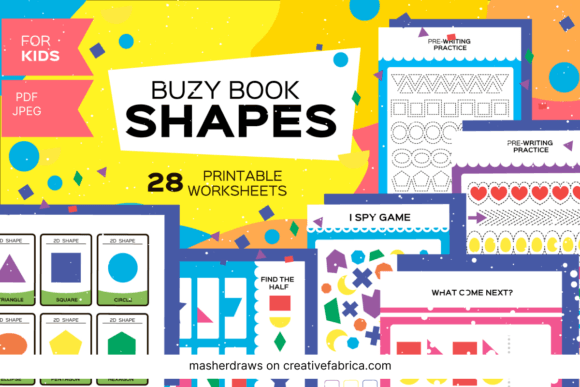
SHAPES BUSY BOOK: 28 Worksheets for Early Geometry and Handwriting
Early childhood education relies heavily on the development of fine motor skills and foundational cognitive concepts. For parents, educators, and homeschoolers seeking structured resources to support these developmental milestones, the SHAPES BUSY BOOK. 28 Worksheets offers a targeted approach to learning. This digital resource is designed specifically for toddlers, preschoolers, and elementary-level students who are beginning to explore geometric forms and pre-handwriting techniques. By combining visual recognition with tactile tracing activities, this collection aims to bridge the gap between abstract mathematical concepts and physical dexterity.
Understanding the Resource Structure
The core value of this product lies in its comprehensive yet focused curriculum. Unlike generic activity books that may lack pedagogical structure, this set includes 28 original pages organized into distinct learning modules. The content is delivered as a digital download, providing users with one PDF file along with 28 JPEG and 28 PNG files. This format ensures flexibility, allowing users to print specific pages as needed or integrate individual images into other educational materials.
The worksheets cover a wide spectrum of two-dimensional basic shapes. While many introductory resources limit themselves to circles, squares, and triangles, this book expands the vocabulary to include ellipses, pentagons, hexagons, rectangles, semicircles, rhombuses, parallelograms, stars, right triangles, polygons, crosses, heptagons, trapeziums, octagons, crescents, hearts, arrows, ovals, trefoils, quatrefoils, and rings. This extensive list ensures that children are exposed to both standard geometric figures and more complex forms, fostering a deeper understanding of spatial relationships.
Educational Components and Learning Activities
The SHAPES BUSY BOOK. 28 Worksheets is divided into several key activity types, each serving a specific educational purpose. Understanding these components helps caregivers determine if the material aligns with their child’s current learning stage.
- Flashcards and Recognition: The inclusion of four learn shapes flashcard pages provides a quick reference tool. These can be cut out and laminated for durability, creating a reusable resource for daily review. Flashcards are essential for building visual memory and associating names with forms.
- Cognitive Matching Games: Four find half pages and four shadow matching games challenge children to analyze shapes critically. These activities require learners to identify symmetrical halves or match objects to their silhouettes, enhancing visual discrimination skills.
- Observation and Logic: The four I spy mathematics games encourage active observation. By searching for specific shapes within a busy scene, children practice focus and pattern recognition. Additionally, four "what comes next" pages introduce basic sequencing and logical prediction, which are precursors to more advanced mathematical reasoning.
- Pre-Handwriting Practice: Eight handwriting practice pages are dedicated to tracing shapes and lines. This is a critical component for developing the fine motor control necessary for writing. Tracing curved and straight lines helps strengthen hand muscles and improves hand-eye coordination.
Benefits for Early Learners
One of the primary advantages of using this worksheet set is its dual focus on math skills and motor development. Many educational tools isolate these areas, but integrating them allows for more holistic learning. As children trace the outline of a hexagon or a trefoil, they are not only memorizing the shape’s name but also physically experiencing its structure. This kinesthetic learning approach reinforces memory retention.
Furthermore, the variety of shapes included supports vocabulary expansion. Introducing terms like "parallelogram," "trapezium," and "quatrefoil" at an early age demystifies geometry. It prepares children for elementary math curricula where precise terminology becomes increasingly important. The progressive nature of the activities, from simple recognition to complex tracing, ensures that learners remain engaged without becoming overwhelmed.
Practical Considerations and Tradeoffs
While the SHAPES BUSY BOOK. 28 Worksheets offers significant educational value, potential users should consider certain practical aspects. As a digital download, it requires access to a printer and paper. For families or classrooms with limited printing resources, this may represent an ongoing cost. However, the ability to reprint damaged pages or create multiple copies for group activities can offset this expense over time.
Another consideration is the need for preparation. To maximize the longevity of the flashcards and matching games, laminating is recommended. This adds an initial time investment for parents or teachers. Those seeking an instant, no-prep solution might find this requirement cumbersome. However, the tradeoff is a durable, reusable set of materials that can withstand repeated use by toddlers.
Additionally, while the range of shapes is extensive, some younger toddlers may find complex forms like the heptagon or quatrefoil challenging. It is advisable to start with basic shapes such as circles and squares before progressing to more intricate polygons. Caregivers should scaffold the learning experience, ensuring that the difficulty level matches the child’s developmental readiness.
Ideal Use Cases
This resource is particularly well-suited for several specific scenarios. Homeschoolers will appreciate the structured curriculum that aligns with early math standards. The mix of game-like activities and formal tracing exercises provides a balanced daily routine. Daycares and preschool classrooms can benefit from the printable format, allowing teachers to create individualized packets for students or set up rotating learning stations.
Parents looking for screen-free entertainment during travel or quiet time will also find value in these worksheets. The "I spy" and matching games are engaging enough to hold a child’s attention while reinforcing educational concepts. Moreover, the digital nature of the product means it can be accessed immediately, making it a convenient option for last-minute lesson planning or unexpected free time.
When to Consider Alternatives
Despite its strengths, the SHAPES BUSY BOOK. 28 Worksheets may not be the ideal choice for every situation. If a child requires interactive, dynamic feedback, digital apps or physical manipulatives like shape sorters might be more effective. Worksheets are static and do not provide immediate correction or adaptation to the learner’s pace.
Additionally, for children with significant fine motor delays, the tracing pages might need to be supplemented with other therapies or tools. While the large lines and simple shapes are designed for beginners, some learners may require specialized occupational therapy resources. In such cases, this workbook can serve as a supplementary practice tool rather than a primary intervention method.
Making the Decision
Choosing the right educational material depends on your specific goals and the learner’s needs. If you are seeking a cost-effective, versatile, and comprehensive resource to introduce 2D shapes and improve handwriting, this 28-page set is a strong candidate. Its blend of recognition, logic, and motor skills practice offers a well-rounded approach to early geometry.
Before purchasing, assess your printing capabilities and willingness to prepare materials through cutting and laminating. If you are comfortable with these steps, the SHAPES BUSY BOOK. 28 Worksheets can become a staple in your educational toolkit. It provides a solid foundation for mathematical thinking and writing readiness, supporting children as they transition from toddlerhood into their elementary school years. By integrating these exercises into regular learning routines, caregivers can help children build confidence and competence in both math and motor skills.